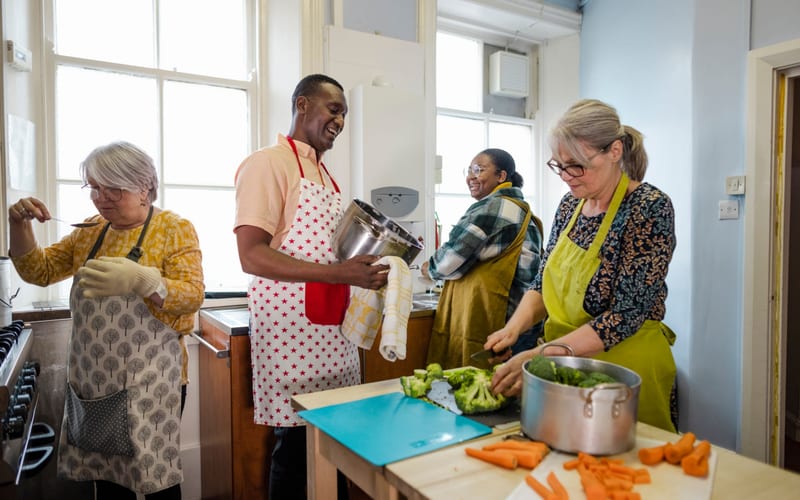
Cooking at shelters
Women's shelters, homeless shelters, and soup kitchens feed large numbers of people every day on some of the tightest budgets imaginable. The cooks who run these kitchens need recipes built from low-cost staples that scale well, deliver real nutrition, and offer enough variety that clients feel fed rather than just processed.
The Facts
- Shelters often operate on a ‘shoestring’ budget
- Shelter kitchens need to build meals around low-cost staples that store well
- Recipes need to scale well and provide real sustenance
- Variety matters as much as nutrition
- Online content creators can be a source of inspiration for shelter kitchen cooks
Most shelters can only provide the very base level for survival, food, water, warmth, and a place to sleep. Even when there are additional services on offer, staying at a shelter is stressful and it is usually an exhausting and uncertain experience.
The cooks in shelters and soup kitchens are often volunteers, who work under very challenging conditions. Money is tight, the number of meals is large, and equipment may be limited. Being able to serve warm, nourishing meals with dignity is essential in that context and it is truly a labour of love.
Budget staples are the foundation of all meals: Lentils, chickpeas, and beans are among the cheapest sources of protein and fibre. Rice, oats, and barley are filling and nutritious. Potatoes, carrots, turnips, and sweet potatoes are cheap, store well, and hold up to long cooking times. Canned tomatoes, onions, garlic, and a small selection of dried spices can transform these staples into dozens of different dishes. The goal is not to work with a long list of ingredients, but to work very well with a short one.
Variety is a form of respect rather than a luxury, because shelter clients may be eating there sometimes for several weeks or months. A rotating menu of eight to ten dishes, each built from the same core staples but seasoned and assembled differently, can provide meaningful variety without increasing costs. A pot of lentils becomes dal one day, lentil soup the next, and a lentil and rice pilaf the day after. The main ingredient is the same, but the meal is different.
Cooking in advance is often essential, because volunteer labour cannot always be predictable, while meal schedules are carved in stone. Dishes that can be fully prepared the day before and reheated just before being served remove a great deal of pressure from the day itself. Building a kitchen routine around advance preparation can make service calmer and more consistent.
Soups, stews, curries, and chilis can be prepared ahead and usually taste even better after a night in the refrigerator.
Baked goods, cooked grains, mashed potatoes, and chopped vegetables can be prepared ahead and held safely.
Dishes that work well in a shelter or soup kitchen setting
- Lentil soup: One of the most economical dishes in any kitchen. Lentils don’t need soaking, cook quickly, and absorb seasonings well. A pot of lentil soup with onions, garlic, cumin, and canned tomatoes costs very little per serving and is genuinely satisfying. Served with a slice of bread it provides complete proteins.
- Rice and bean stew: A combination of cooked rice and seasoned beans — black, kidney, or pinto — is filling, high in protein and fibre, and can be flavoured in many directions depending on the spices used. It scales to any quantity and holds well.
- Chickpea and vegetable curry: A large pot of curry built around canned chickpeas, canned tomatoes, onions, and whatever vegetables are available is a very versatile dish. It can be made mild or spiced to taste, and it improves significantly overnight. Serving it over rice provides complete protein without meat.
- Pasta with tomato and lentil sauce: Adding cooked lentils to a simple tomato sauce stretches the sauce, adds protein, and reduces the cost per serving. Served over pasta with a little grated cheese, it is a complete and satisfying meal.
- Oatmeal with toppings: For breakfast, a large pot of oatmeal set out with small bowls of brown sugar, cinnamon, raisins, and sliced banana gives clients a warm, filling meal with a sense of choice, at a minimal cost per serving.
- Vegetable and barley soup: Barley is one of the most underused grains in budget cooking. It is inexpensive, filling, and thickens a broth naturally as it cooks. Combined with whatever vegetables are on hand and a simple stock, it makes a hearty soup that holds well and reheats beautifully.
Content creators on YouTube and other platforms focus specifically on cooking for shelters, food banks, and community kitchens. It’s worth checking out the practical knowledge they share: how to season a large pot so it tastes good all the way through, how to adjust recipes that were written for four people to feed forty or four hundred, how to manage food safety at scale, and how to keep costs down while keeping clients satisfied.
Here are a few channels and websites worth checking out:
- Senpai Kai has posted several short videos about cooking for the homeless. His ideas range from sandwiches with unusual ingredients, such as butter chicken, to chili. His techniques are simple, and his meal ideas are based on few ingredients. Sometimes just switching up seasonings and condiments can make a big difference to an otherwise simple meal.
- From Heart to Hand is a San Francisco street outreach mission. Their recipes range from soups, stews, cheeseburgers, subs, and tacos to udon, garlic chicken with rice, and chow mein. Each video puts a human face on homelessness.
- Kr3w Kali has 547k followers and specializes in protein-rich, comforting meals for the street community. Whether it's 100 pounds of orange chicken, chili, BBQ ribs, and cheeseburgers, or 200 pounds of omelettes, Kr3w Kali shows how it's done.
- Simple Meals for Homeless Shelters by Platter Talk is a blog where Dan and Scott reflect on the challenges of being homeless, and share easy casseroles and other meal ideas that are suitable for soup kitchens and shelters.